About 6× less RAM
than Node-RED
on the same flow.
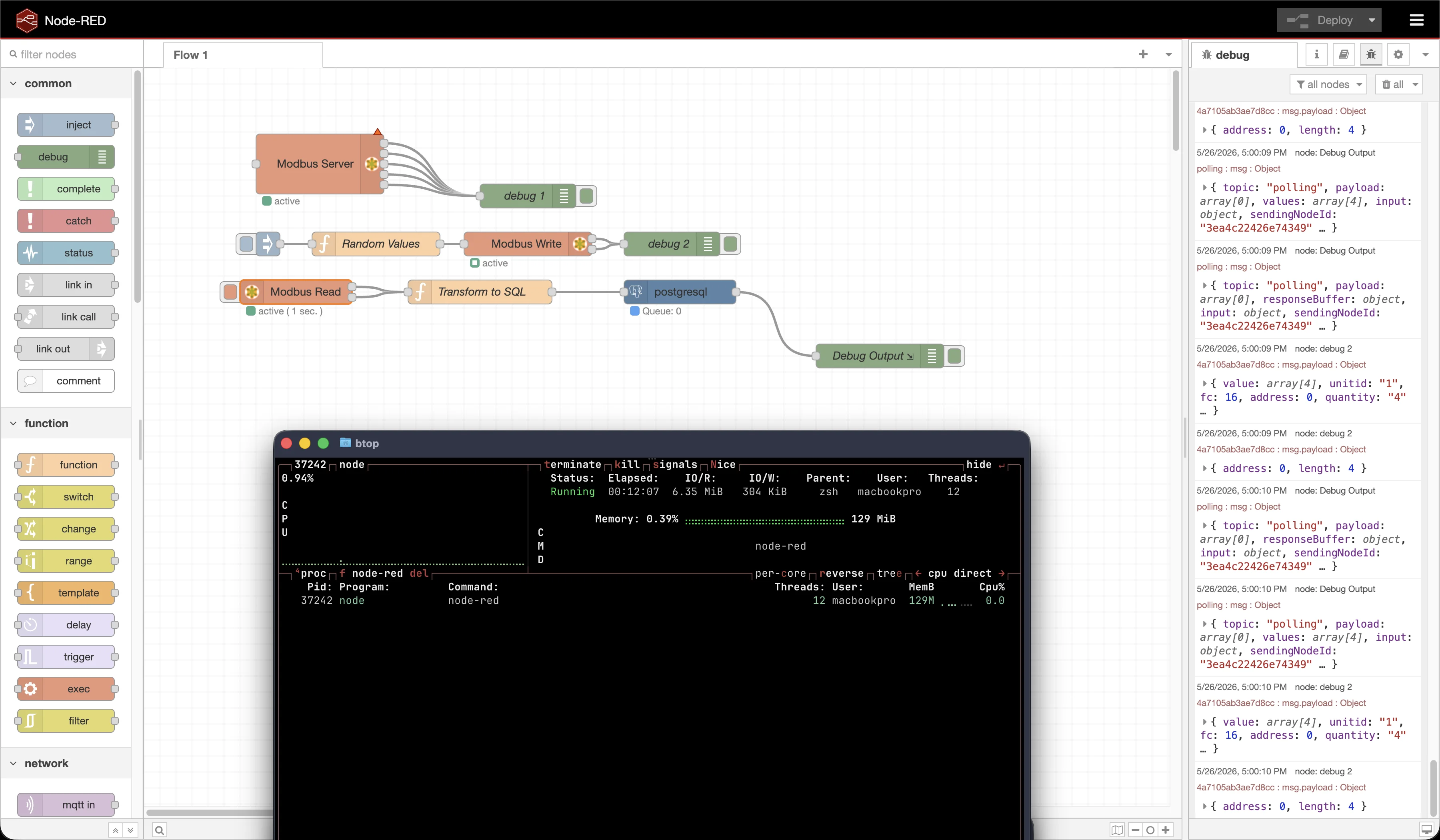
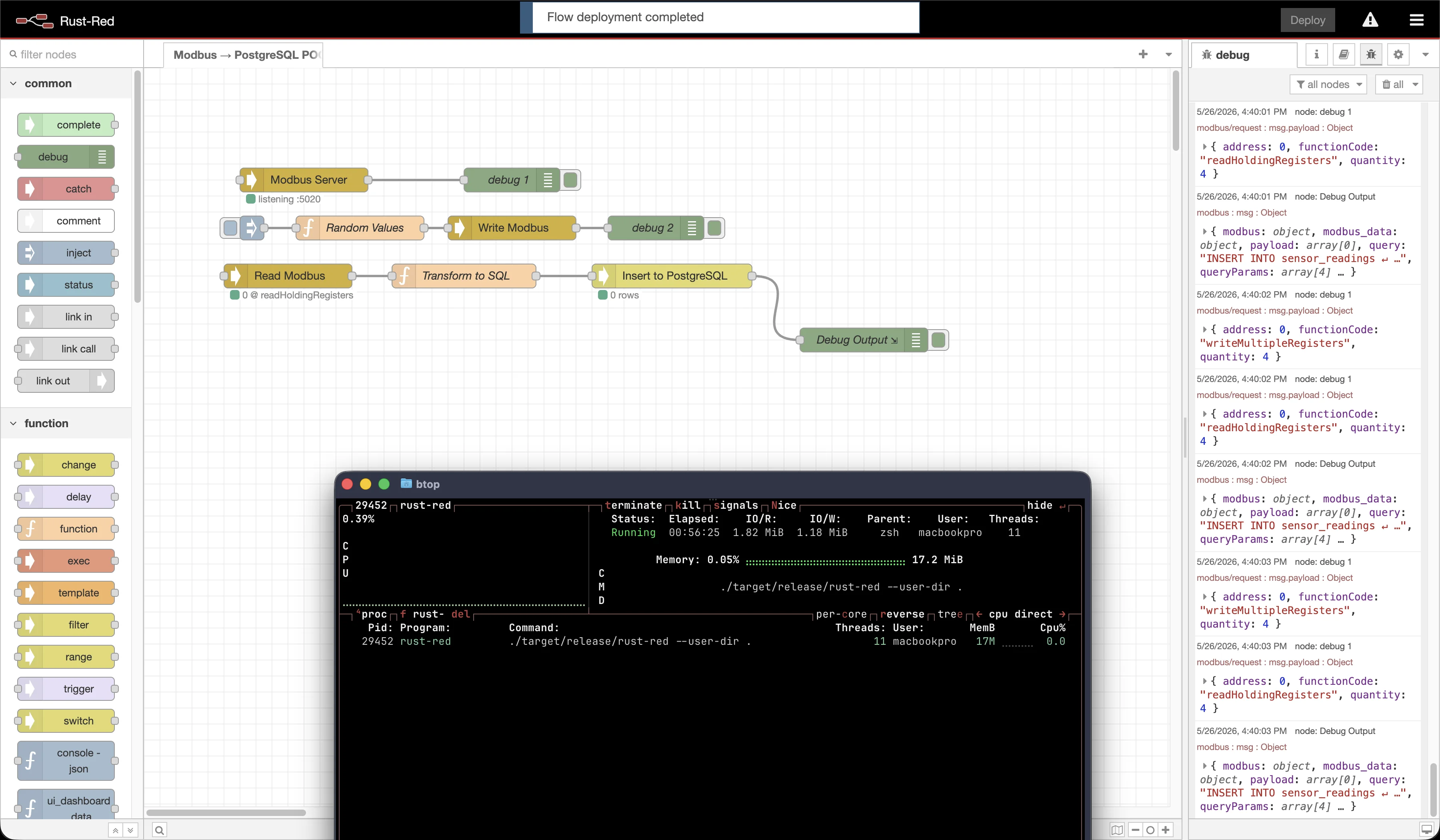
One Modbus-to-PostgreSQL flow, measured twice. On a MacBook Pro M1 Pro (32GB): RustRED 17.2MB RAM at 0.39% CPU, Node-RED 129MB at 0.94% CPU. Reproduced on Linux x86_64: 20.4MB at 0.20% CPU against 126MB at 0.71%. RustRED is a fork of EdgeLinkd by Li Wei (Apache-2.0).
Node-RED · MacBook Pro M1 Pro
129 MB RAM · 0.94% CPU · Node.js
RustRED · MacBook Pro M1 Pro
17.2 MB RAM · 0.39% CPU · Rust (Tokio)
Linux method: pymodbus 3.6.9 simulator, PostgreSQL 16 in Docker, 10 holding registers polled every 500 ms, a function node building one INSERT per poll (about 2 rows/s on both sides, confirmed by row counts). 30 s warm-up, then 60 s sampled once per second; RAM is resident memory from /proc, CPU is user plus system time over wall-clock time. RustRED was the full build; Node-RED ran node-red-contrib-modbus and node-red-contrib-postgresql. The RustRED flow uses RustRED’s own node types. One machine, one flow: your numbers will differ. Details in the README.
Demo video
Watch the demo
A Node-RED compatible flow runtime in Rust: one binary, the built-in editor, import a flow and deploy, live debug data, a built-in MQTT broker, Modbus, and the footprint comparison.
Chapters
01: The Problem
Your flow automation shouldn't need
a full server to run.
Node-RED brought visual flow programming to everyone. But on small devices and in production, teams hit the same walls: a heavy runtime and npm supply-chain risk.
About 6× less RAM
On the same Modbus-to-PostgreSQL flow Node-RED used 129MB on an M1 Pro Mac and 126MB on Linux. RustRED used 17.2MB and 20.4MB. With an empty flow, the default build idles at about 15MB on Linux x64.
Supply-Chain Risk
Every npm install is a risk, and Node-RED nodes run with full access to the process. RustRED nodes are Rust code compiled into the binary from source you can read. There is no runtime package install.
No runtime to install
Node-RED needs Node.js and an npm install on every device. RustRED is a native binary plus the editor folder, so a flow runner is two things to copy. We have not benchmarked cold start time.
02: Features
Built for production.
Engineered for reliability.
RustRED runs flows built from Node-RED’s core nodes with a small memory footprint. Voltrus can host an instance for you, in early access.
Low overhead
Native async runtime on Tokio, no garbage collector. On the same Modbus-to-PostgreSQL flow it used 0.39% CPU where Node-RED used 0.94% (M1 Pro), and 0.20% against 0.71% on Linux.
Auditable custom nodes
Custom nodes are Rust crates in node-plugins/, compiled into your own build. Review the code, then ship the binary. An experimental WASM plugin host exists in the full feature set; release binaries do not include it.
Small deployment
A 17.0MB binary (default build; about 24MB with --features full) and an editor folder. No Node.js, no Docker, no package installs. Release archives for Linux and macOS, x86_64 and aarch64.
Node-RED flow format
Flows built from core nodes import and run, and the Node-RED editor is included. Stock MQTT nodes and the node-red-contrib-modbus and node-red-contrib-postgresql nodes run as exported.
Build only what you need
Protocols, databases, clustering and AI support sit behind cargo feature flags, so you can build a smaller binary for constrained devices.
Industrial and database nodes
Modbus, OPC-UA, BACnet, MQTT (with an embedded broker node), PostgreSQL, TimescaleDB, MSSQL, SQLite and InfluxDB nodes, all in the default build.
03: Compare
How it compares to what you're using now
See how RustRED stacks up against the tools you're already using. Built for the same workflows, engineered for production.
Self-hosted vs Voltrus
Managed Hosting
RustRED is the engine.
Voltrus Cloud runs it for you.
Self-host RustRED for free, or have us run and update an instance for you. Cloud is in early access: we are onboarding the first customers by hand.
We run and update it
No server to provision or patch. We run your RustRED instance in our Singapore region and keep it updated.
Sign-in in front of the editor
The flow editor sits behind your Voltrus sign-in, so it is not open on the internet.
Flow snapshots with rollback
Snapshots of your flows, so a bad deploy can be rolled back.
Fixed resource caps
Starter is capped at 128 MB of memory and about 100 messages per second per instance. Pro is capped at 512 MB and about 500 messages per second.
Migration help
Send us your Node-RED flows. We tell you which nodes import as they are and which do not, and help you fix the rest.
On-premise for Enterprise
Enterprise customers can have RustRED installed on their own servers or in their own cloud, with support agreed per contract.
04: Use Cases
Built for edge, IoT, and industrial automation.
From factory floors to solar farms to smart buildings: anywhere you need lightweight, reliable flow automation that runs on constrained hardware.
Industrial IoT Gateways
Run flow automation on Raspberry Pi or industrial gateways with 512MB RAM. Collect data from Modbus devices, transform, and publish to MQTT.
PLC Data Collection
Poll PLCs over Modbus TCP/RTU, aggregate data, and push to PostgreSQL/TimescaleDB for dashboarding. One binary, no middleware stack.
Solar & Energy Monitoring
Collect inverter data, meter readings, and weather station values. Transform and forward to cloud platforms via MQTT. Runs on a Raspberry Pi.
Building Automation
Connect HVAC controllers, lighting systems, and sensors. Route data between BACnet, Modbus, and MQTT protocols with visual flows.
Node-RED Migration
Try your existing Node-RED flows on a smaller runtime. Flows made of core nodes, stock MQTT, node-red-contrib-modbus and node-red-contrib-postgresql nodes run as exported.
Edge Computing
Copy a 16MB binary and the editor folder to your edge devices. Linux and macOS builds for x86_64 and aarch64.
Part of: Monitor & connect · See the plant: dashboards and alarms, machine OEE, remote access, messaging.
How RustRED differs from…
-
Voltrus Gateway
Voltrus Gateway is a typed gRPC API over seven PLC protocols, for code. RustRED is a flow runtime where you wire the logic.
-
Voltrus Broker
Voltrus Broker is a managed, dedicated MQTT broker. RustRED is free, and you run it yourself.
05: FAQ
Common questions
node-red-contrib-modbus or node-red-contrib-postgresql run as exported too. Credentials in flows_cred.json are not read, so add them to the config nodes. A config node that fails to load is logged and disabled, and the rest keeps running. Start by running rust-red run flows.json and read the log.node-plugins/, annotate the node with the flow_node macro, and build RustRED. The node is compiled into your binary. The repository also contains an experimental WASM plugin host, which is part of the full feature set and not in release binaries../rust-red run flows.json. Then open http://127.0.0.1:1888. To build from source, clone the repository with --recursive and run cargo build --release, or run cargo install --git https://github.com/dzulfikar08/rust-red for the binary alone (without the editor files).Pricing
Start free.
Let us host it when you want.
RustRED is free and open source (Apache-2.0). Voltrus Cloud is in early access: we run and update an instance for you.
Self-Hosted
Free
Apache-2.0 · Fork of EdgeLinkd
- ✓ RustRED runtime and editor
- ✓ Modbus, OPC-UA, BACnet, MQTT, PostgreSQL, SQLite, InfluxDB and more
- ✓ Imports Node-RED flows built from core nodes
- ✓ Linux and macOS builds
- ✓ Community support on GitHub
Cloud Starter · early access
$15 / month
or Rp 150.000 / month, per instance. Pay yearly, get 2 months free ($150 or Rp 1.500.000).
- ✓ 1 RustRED instance
- ✓ 128 MB memory cap
- ✓ Up to ~100 messages/s
- ✓ Editor behind your Voltrus sign-in
- ✓ Flow snapshots with rollback
- ✓ Singapore region
- ✓ Email support
Cloud Pro · early access
$29 / month
or Rp 250.000 / month, per instance. Pay yearly, get 2 months free ($290 or Rp 2.500.000).
- ✓ Everything in Starter
- ✓ 512 MB memory cap
- ✓ Up to ~500 messages/s
- ✓ More projects
- ✓ Priority email support
Enterprise
Custom
On-premise or your cloud
- ✓ On-premise installation
- ✓ Support agreed per contract
- ✓ Migration help for Node-RED flows
Early access. We are onboarding the first customers by hand. Request access and we reply within two business days.
Get Started
Run RustRED free.
Or have us host it.
RustRED is free and open source (Apache-2.0). If you would rather not run it yourself, ask for Voltrus Cloud early access.
Services
Help when you
want it.
Migration help
Send us your Node-RED flows. We check which nodes import as they are and which do not, and help you fix the rest.
Managed hosting
Voltrus Cloud is in early access. We run your instance in Singapore and keep it updated.
On-premise installation
For Enterprise customers: we install RustRED on your servers or in your cloud, with support agreed per contract.
Also from Voltrus