Teaching Lean Manufacturing with a 5S Factory Simulator
Ask a trainee to define 5S and you will get the list: Sort, Set in Order, Shine, Standardize, Sustain. Ask them what a red-tagged item costs the line, or why an unsorted workstation slows every pick, and the list stops being useful. Lean concepts only land when learners feel them — and on a live floor, feeling them costs production. A lean manufacturing simulator closes that gap: the mistakes happen on a virtual floor, and the bill arrives in the same session.
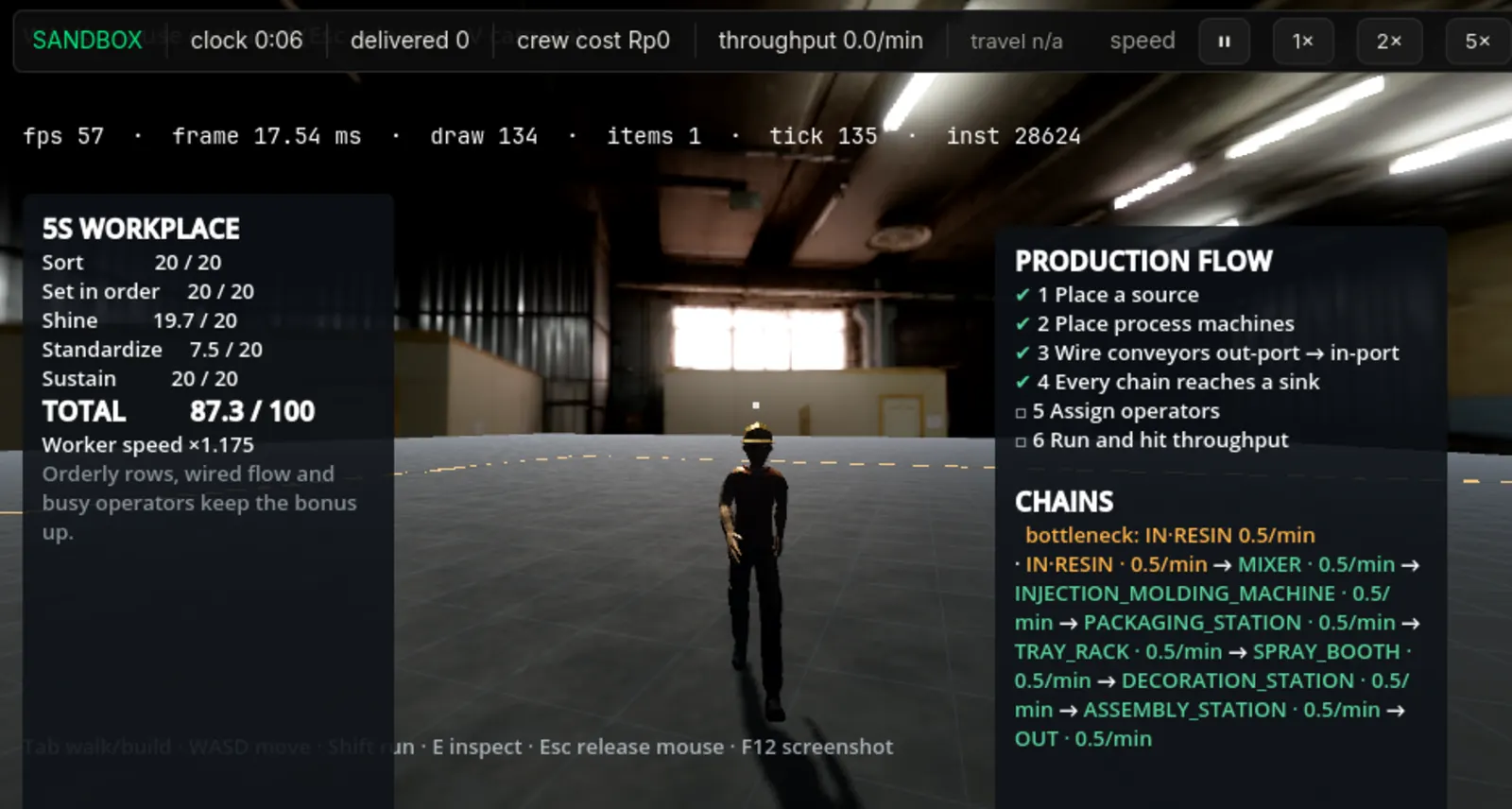
A 5S Audit You Can Watch Happen
In Voltrus Factory, 5S is not a slide — it is a live score that responds to the layout as you build it. Every time a trainee drops a machine, lays a belt, or leaves an output unwired, the workplace-organization score moves. A disciplined, sorted floor earns a worker-speed bonus: the simulated operators literally move faster in a well-organized plant, so 5S stops being a compliance checklist and becomes a performance lever the learner can pull.
Because the score updates live, the trainer's job changes. Instead of announcing the criteria, run a 5S audit against the simulator itself: pause the session, open the score, and ask the group why it moved. The evidence is on the screen — the pile of unwired outputs, the conveyor crossing a walk path, the station nobody can reach. Debriefs like this stick in a way the list never did.
Muda Tracking: The 7 Wastes, Priced Live
The second pillar is muda. Voltrus Factory tracks all 7 wastes — transport, inventory, motion, waiting, overproduction, overprocessing, and defects — and costs each one as it happens. When a trainee runs material across the hall by hand instead of pinning a route, the transport waste ticks up in currency, not in abstraction. When a chain dead-ends, the inventory and waiting numbers climb while the group watches.
This converts the classic lean training exercise into an economics lesson. The question shifts from "which waste is this?" to "what is this waste costing per minute, and what would fixing it cost?" That second question is the one a real improvement proposal has to answer, and trainees have now practiced it dozens of times before anyone hands them a kaizen form. For the underlying taxonomy, see our breakdown of the 7 wastes of lean manufacturing with examples.
Deterministic Runs Make Training Fair
A subtler teaching problem: two groups run the same exercise, get different results, and the debrief turns into an argument about luck. Voltrus Factory's simulation core is deterministic — same layout, same orders, same outcome, every run. When two trainee teams ship different throughput from identical scenarios, the difference is fully explained by their decisions. That property is what makes the simulator a serious training instrument rather than a game with lean decoration.
The industry campaigns carry the format: discrete assembly, injection molding, dairy, chemical, food, and BOPP film scenarios, each with a budget, a production target, and a clock. Hand the same campaign to every cohort and you have a repeatable, comparable exercise — the classroom equivalent of a standard work.
A Session That Works in 90 Minutes
A practical structure for trainers:
- 0–15 min: Build a minimal line in the sandbox — source, two machines, conveyor, sink. Watch the production-flow panel confirm every chain.
- 15–40 min: Deliberately degrade it. Cross belts over walk paths, orphan an output, stack work in front of the slow station. Let the muda costing and the 5S score react.
- 40–70 min: Improve it. Rewire routes with pins and transporters, rebalance around the highlighted bottleneck, and chase the throughput forecast upward.
- 70–90 min: Debrief against the numbers: what moved, why, and what the same fix would cost on the real floor.
Nothing needs installing to try it: the sandbox plays in the browser at factory.voltrus.id, and the desktop builds run offline in the training room. It is free during beta. If you are also teaching flow analysis, pair the session with our guide to bottleneck analysis on production lines, and see how a digital factory scores 5S in more depth.
The full picture — 3D builder, walk mode, routing overlay, and campaigns — lives on the Voltrus Factory product page.
Frequently Asked Questions
Is a simulator realistic enough for lean training?
It is realistic where training needs it to be: the wastes are the same categories, the trade-offs are the same (transport distance vs investment, sorting vs walking time), and the sim is deterministic so cause and effect are unambiguous. It does not model your plant's specific machines — it teaches the reasoning you then apply to them.
Do trainees need engineering backgrounds?
No. Building a line is grid-based and drag-lay, and the panels explain themselves with statuses like OK, unwired, and dead-end. IE students get the vocabulary faster; operators and supervisors usually arrive knowing the floor and pick up the scoring immediately.
How do I compare cohorts fairly?
Give every cohort the same campaign level and let the deterministic sim do the rest: identical scenario, identical clock, so throughput and waste-cost differences are attributable to decisions alone.
Run Your Next Lean Session on a Virtual Floor
Voltrus Factory is free during beta — desktop builds for Windows and Linux, plus a no-install browser sandbox.
See Voltrus Factory