Conveyor vs AGV: Choosing Material Transport with a Discrete-Event Factory Sim
Material transport is where layout projects quietly succeed or fail. Conveyors are cheap per meter and utterly inflexible; AGVs are flexible and carry a fleet-management tax; people with carts are the most flexible of all and the most expensive at scale. Every plant answers the question differently, and the honest answer is: it depends on the flow. The way to find out what it depends on in your plant is a material handling simulation — build the layout once, swap the transport mode, and compare.
The Conveyor Case: Fixed Paths, Predictable Cost
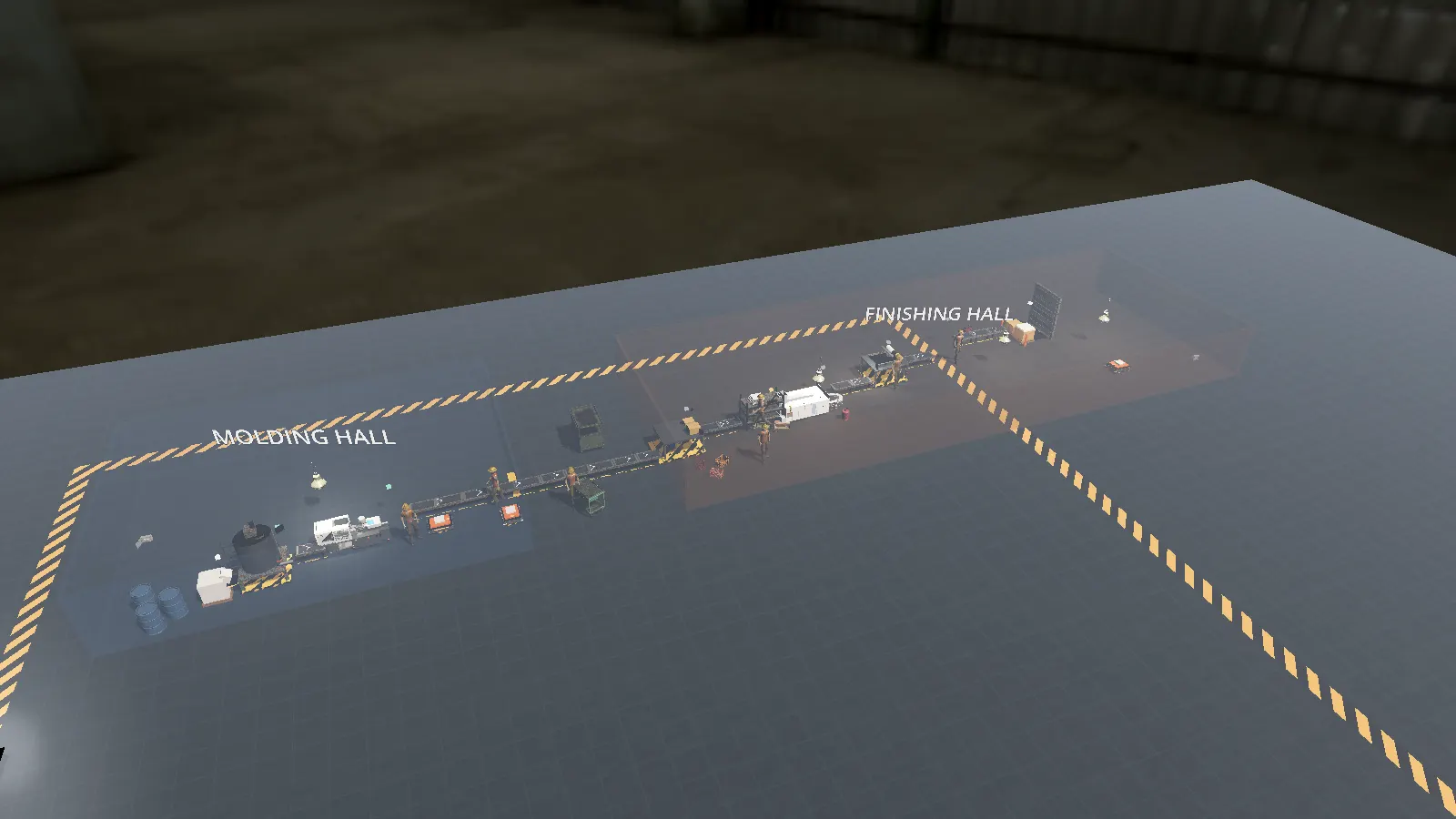
Conveyor systems design is the discipline of committing early. A belt is a promise: this part travels this path, at this speed, forever. That is excellent when the flow is stable and dense — high-volume molding to finishing, packaging to dispatch — because nothing beats a conveyor for deterministic, zero-manning transport along a fixed corridor. Drag-lay belts in Voltrus Factory reproduce exactly this: a route you can read from across the hall, with directional chevrons marking every move.
The cost of the promise is rigidity. A belt occupies floor and blocks crossings; reroute the flow and you are rebuilding steel. In the simulator, that shows up as a layout that scores beautifully on one chain and drags the rest of the plant through detours — visible immediately in the per-chain throughput forecast, and costed as transport muda while it happens.
The AGV Case: Flexibility With a Fleet Tax
AGVs invert the trade. No fixed path: you pin an output, and a transporter or AGV carries it anywhere in the hall. When flows change with product mix — exactly the situation in the injection molding, food, and BOPP campaign scenarios — that flexibility is worth real money. AGV simulation exists because the flexibility is not free: vehicles queue at pickup points, traffic concentrates on shared aisles, and a fleet that is one vehicle too small silently becomes the new bottleneck.
A discrete-event sim answers the fleet-sizing question by experiment, not by vendor brochure. Add a vehicle, re-run, and watch whether chain throughput moves. Voltrus Factory is deterministic — same layout and orders, same outcome — so a one-AGV difference in the forecast is a real difference, not simulation noise. And because the muda costing is live, waiting waste caused by an undersized fleet is priced in the same run.
Manual Transport: The Baseline Worth Measuring
The default in most mid-size plants is neither — it is people moving material by cart. Keep it in the comparison. Manual transport scales its cost linearly with distance and volume, generates motion and waiting waste you can see on the floor, and in the simulator it is often the option that makes AGVs look cheap. The comparison view in Voltrus Factory puts all three — AGV fleet, conveyors, manual — side by side on the same layout, so the investment decision is a row of numbers instead of a meeting anecdote.
How to Run the Comparison in One Afternoon
- Build the plant once. Sources, machines, sinks on the grid; leave transport disconnected first. The production-flow panel will list every chain as unwired — that list is your scope of transport work.
- Wire it with conveyors. Drag-lay belts along the shortest corridors. Note per-chain parts-per-minute and where the bottleneck highlight lands.
- Swap the long routes to pins and AGVs. Keep conveyors on dense, stable links; let transporters handle the long hauls and the awkward crossings. Re-run and compare.
- Stress the layout. Change the product mix (or run a campaign level with a different order book) and see which transport mode degrades first. The mode that survives the mix change is usually the one worth buying.
The browser sandbox at factory.voltrus.id runs this exact workflow with nothing installed, and the Voltrus Factory desktop builds do it offline, free during beta.
Which One Wins?
In the simulator, as on the floor: conveyors win dense, stable, high-volume corridors; AGVs win long, variable, multi-drop routes; manual wins low volume and wins it cheaply — until it doesn't. The value of the discrete-event model is that the crossover points become visible before the purchase order. Pair this with the method behind the numbers in our bottleneck analysis guide, the 7 wastes breakdown, and the layout-first walkthrough in factory layout software: simulate the line before you move a single machine.
Frequently Asked Questions
Can I mix conveyors and AGVs in the same layout?
Yes, and you should. Routing pins let an output hand off between modes — a conveyor for the dense corridor, a transporter for the crossing to finishing. The flow panel validates every chain regardless of which transport carries it.
How do I know if my AGV fleet is the right size?
Size it by experiment: run the same layout with one vehicle fewer and one more. In a deterministic sim, throughput that fails to improve with an added vehicle tells you the fleet is no longer the constraint — spend the money elsewhere.
Does the simulation account for AGV traffic congestion?
The discrete-event sim models transport as a shared resource, so vehicles queue where routes compete, and the effect shows up in per-chain throughput and waiting waste. If two pinned routes collide on one aisle, the forecast says so.
Compare Conveyors, AGVs, and Manual — Before You Buy Any of Them
Voltrus Factory is free during beta. Play in the browser or download the Windows / Linux desktop build.
See Voltrus Factory